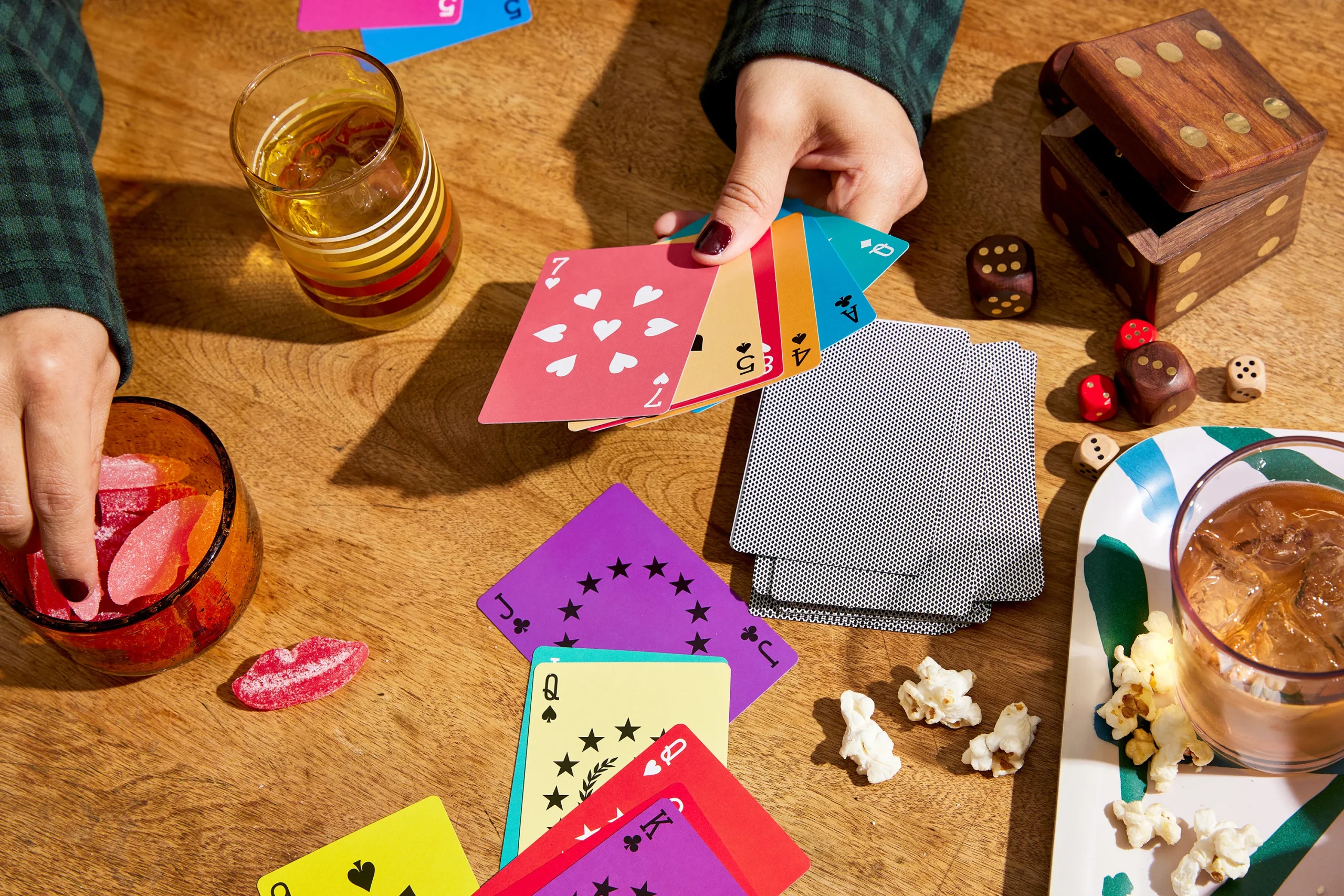
Turn-taking is polite. It’s also slow. Some groups want the opposite: everyone acting at once, hands moving, eyes scanning, and the table making noise for reasons other than conversation. That’s where card games with no turns come in—games built around simultaneous play, real-time pressure, or “first to do it correctly” rules instead of orderly clockwise turns.
And yes, some of these can work as 2 player card games too—sometimes even better, because you can play at full speed without waiting for a table.
What “no turns” really means (three main styles)
Most “no turn” card games fall into one of these patterns:
1) Simultaneous decisions
Everyone chooses or reveals at the same time. The tension comes from prediction and timing, not from waiting.
2) Real-time action
Cards are played continuously; players react immediately when patterns appear. Think speed, recognition, and hands-on play.
3) Race mechanics
There’s still a structure, but no one “gets a turn.” Instead, the game is a race to spot, slap, match, or complete something first.
If your group hates downtime, these designs feel like oxygen.
Classic real-time and simultaneous card games worth knowing
Here are well-known examples (kept short—no long lists):
-
Speed (often played with two): both players try to get rid of cards fast, playing onto shared piles whenever legal.
-
Dutch Blitz: players race to shed cards onto shared stacks; it’s chaotic and loud in the best way.
-
Set (technically a card-based pattern game): players spot valid sets simultaneously.
-
Snap / Slapjack (rules vary): players react when a match condition appears.
-
Jungle Speed: pattern recognition plus a physical race element.
Even if you’ve never played them, you’ve felt their DNA: minimal waiting, maximum reaction.
How to pick the right “no turns” game for your group
A quick way to choose is to match the game to what your players enjoy:
If you like reflexes
Choose games where physical speed matters: slap/match/race mechanics.
If you like pattern spotting
Choose games where the table is a puzzle: spotting combinations, shapes, or sequences.
If you like “simultaneous strategy”
Choose games where you plan privately then reveal together—less chaotic, more mind-game.
This matters because “no turns” can mean “fun chaos” or “stressful chaos,” depending on temperament.
Making “no turns” work as 2 player card games
Two-player versions often feel cleaner because the table state is easier to read. But you may need a small tweak to keep it fair:
-
Add a fixed rhythm rule (e.g., you can only play one card per second) if one player is dramatically faster.
-
Use larger, clearer piles so recognition isn’t the bottleneck.
-
Agree on what counts as a valid move before you start—real-time games break when rules are fuzzy.
In a Jakarta living-room setting—music on, snacks nearby—clarity matters even more. Real-time games don’t tolerate “wait, does that count?” debates.
The main downside (and how to avoid it)
No-turn games can create two common problems:
-
Rule disputes at speed
Fix: use simple win conditions and test-play one round slowly. -
Skill gap blowouts
Fix: handicap lightly (smaller hand size for the faster player, or “one-hand-only” play), or choose a pattern game where speed matters less than accuracy.
The goal is shared excitement, not one person farming wins.
A subtle observation beginners miss
In turn-based games, you can recover from a mistake because you’ll get another calm decision later. In no-turn games, mistakes compound fast—because the table doesn’t pause to let you breathe.
So beginners improve fastest when they focus on accuracy first, speed second. The funny part: once accuracy is automatic, speed arrives on its own.
Card games with no turns replace orderly rotation with simultaneous decisions, real-time reactions, or race mechanics—less waiting, more energy. If you choose the right style for your group, these games become some of the most replayable 2 player card games and party-table favorites, because the fun isn’t in “my turn”—it’s in the moment everyone moves at once.
About the Author